Imagine you’re a homeowner with a burst pipe at 2:00 AM. You don’t scroll past the first three results to compare brand histories; you click the first “Google Verified” button you see and hit call.
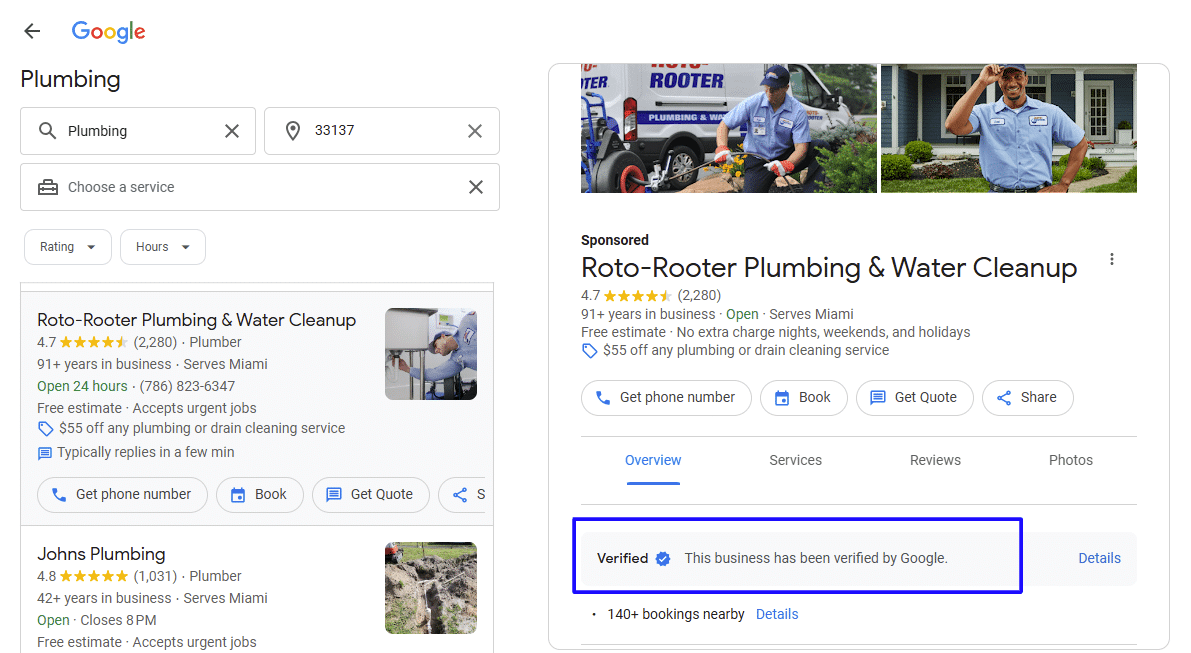
As a business owner, being the first choice is the difference between a booked calendar and a quiet phone. When you look at the top of Google, you see two very different animals: the “Checkmark” ads (LSA) and the “Sponsored” text ads (Google Ads). One charges you for every click, while the other only charges you if the phone actually rings.
One takes weeks to master, and the other is almost “plug and play.”
If you’ve ever felt like you’re gambling with your marketing budget, this guide is for you. We’re breaking down the LSA vs. Google Ads battle so you can stop guessing and start growing.
What Are Local Service Ads (LSA)?
Local Service Ads, also known as LSA, are specialized, trust-driven ads designed specifically for service-based businesses.
Think of Local Service Ads as Google’s “Handshake” with your customers. Unlike traditional search results, the pay-per-lead advertising platform places you in the “Position Zero”: at the absolute top of the page, even above the traditional paid ads.
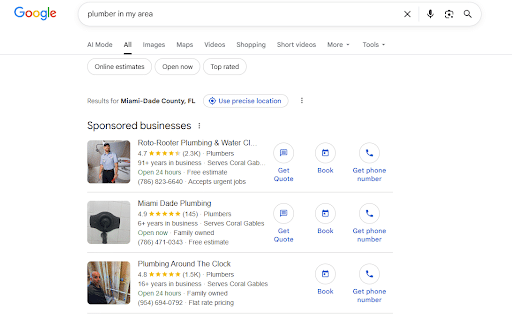
When you click on one of these businesses, you’ll see their full profile along with that coveted ‘gold’ seal of approval: The Google Verified badge.
In 2026, an LSA isn’t just a listing: it’s Google’s way of telling customers they can trust you. By linking directly to your Google Business Profile, they display your real-time reviews and the highly coveted Google Verified badge
Key Features of LSA:
- Pay-Per-Lead Model: You only pay when a potential customer contacts you through a call or message.
- The Google Verified Badge: This blue checkmark confirms you’ve passed Google’s rigorous 2026 screening, including background checks, license verification, and insurance audits.
- Verified Google Business Profile: To qualify, your business must have a verified Google Business Profile. Google verifies your business to ensure trust and authenticity.
- Mandatory GBP Integration: Your ads are now powered by your GBP. Google pulls your star rating, review velocity, and even your “speed to lead” directly from your profile to determine where you rank
- Hyper-Local Targeting: LSAs are locked to your specific service areas. If you don’t serve a zip code, your ad won’t show there, ensuring every lead is geographically relevant.
What Are Google Ads (GA)?
If LSA is a handshake, Google Ads is a digital billboard network. While the previous is restricted to service categories, Google Ads is a blank canvas. It uses a Pay-Per-Click (PPC) model, meaning you are bidding for a spot in the search results to drive traffic specifically to your website or a custom landing page.
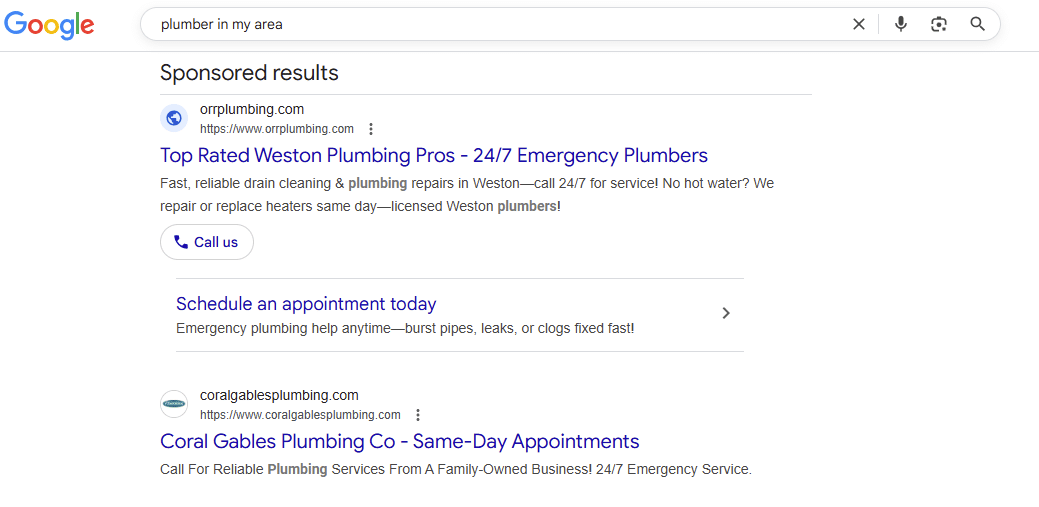
This platform is a comprehensive, keyword-based ecosystem that allows you to target users at every stage of their journey: from someone researching “how to fix a leaky faucet” to someone ready to hire a pro.
Key Features of Google Ads:
- Keyword Mastery: You have total control. You can bid on specific brand names, niche services, or even competitors’ names to capture market share.
- Full-Funnel Reach: Your ads aren’t limited to the top of search. They can appear on YouTube, Gmail, and millions of partner websites via the Display Network.
- Dynamic Messaging: Want to run a “20% Off” weekend special? Google Ads allows you to write custom headlines and descriptions that you can change in real-time to match your current promotions.
- The User Journey Advantage: Google Ads allow you to engage prospects at every stage of their journey. You can build awareness on YouTube while they research, stay top-of-mind via the Display Network as they compare options, and finally secure the lead on the Search Network when they are ready to pull the trigger.
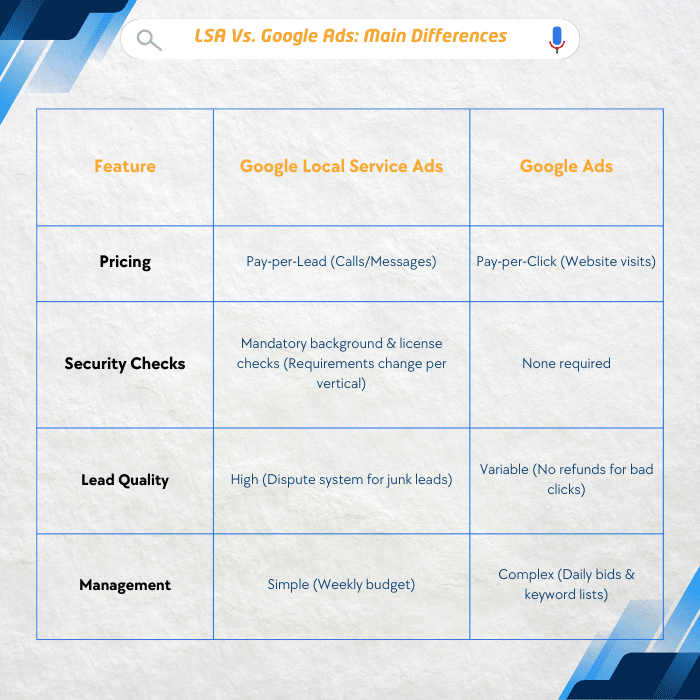
“LSA or Google Ads?” Key Differences Between Local Service Ads and Google Ads
Deciding between LSA and Google Ads can be tricky, but understanding their key differences is the first step in making the right choice for your business.
While both platforms get you on the first page of Google, they are built for different types of wins. Here is how they stack up in the areas that matter most to your bottom line:
1. Placement and Trust Signals
- LSA: These are the “VIPs” of search. They appear at the absolute top. They include your business name, star rating, and the blue Google Verified badge. This badge is a powerful trust signal that tells customers you’ve passed Google’s strict background and license checks.
- Google Ads: These appear just below LSA. They are text-based and marked as “Sponsored.” While they don’t have a verification badge, they allow for much longer headlines and descriptions to sell your unique value.
2. Payment: Pay-per-Lead vs. Pay-per-Click
- LSA (Pay-per-Lead): You only pay when a customer directly calls or messages your business. One of the primary advantages of LSAs is Google’s built-in automated credit system. The platform utilizes machine learning to evaluate lead quality, automatically issuing a credit back to your account balance for invalid interactions like spam, robocalls, or wrong numbers.
- Google Ads (Pay-per-Click): You pay for every click. If a user clicks your ad, spends five minutes on your site, and then leaves without calling, you still pay for that click. Keep this in mind: there are no refunds for clicks that don’t convert.
3. Setup and “The Barrier to Entry.”
- LSA (The High Bar): You can’t just “turn on” LSA. You must pass a rigorous verification process, including background checks for owners (and sometimes field staff), proof of insurance, and valid professional licenses. This high barrier to entry is actually a benefit; it keeps “fly-by-night” competitors off the top of the page. You can find out more about it in our dedicated Local Service Ads resource, which breaks down everything from initial setup to long-term lead management.
- Google Ads (The Open Door): Almost anyone can start a Google Ads campaign in minutes. There is no background check or license verification required to start bidding on keywords.
4. Targeting: Automated vs. Surgical
- LSA (Category-Based): Instead of targeting individual keywords, you select specific service categories. Google then determines when to display your ad based on your business profile setup. Securing a top position in the LSA rankings is far from a passive process; it relies heavily on your initial configuration, strategic budget optimization, and an active management strategy to outmaneuver local competitors.
- Google Ads (Keyword-Based): You choose exactly which searches you want to show up for. You can target “water heater repair” but exclude “water heater installation” if that’s not a service you want more of right now.
Benefits of Using LSA for Your Business
Local Services Ads are designed for one thing: frictionless lead generation. In 2026, they are the most effective way to “shortcut” the traditional search process and get straight to the phone call.
- Prime Visibility: LSA sits at the absolute top of the search results page. In the mobile-first world of 2026, being at the top means you are often the only business a customer sees before they decide to call.
- The Google Verified Badge: This blue checkmark is the new universal trust signal. It tells customers that Google has personally vetted your licenses, insurance, and background checks. This instant credibility significantly increases your conversion rate.
- A Protected Pay-Per-Lead Model: Unlike other platforms, you only pay for actual results. If someone clicks your ad but doesn’t call, you pay nothing. Plus, Google’s built-in system allows you to get credits for “junk leads,” ensuring your budget is only spent on real opportunities.
- Reputation-Powered Ranking: LSA is fueled by your Google Business Profile. The more 5-star reviews you have, the higher your ad climbs, rewarding you for providing excellent service in the real world.
Choose LSA If…
Choose Local Services Ads if direct phone communication is the primary driver of your business growth.. It is the perfect choice for:
- Emergency Services: Plumbers, HVAC, and Locksmiths who need to capture a lead the second a crisis happens.
- High-Trust Professionals: Lawyers and Realtors who need to overcome consumer skepticism with a verified badge of authority.
- The High-Efficiency Marketer: If you want to bypass the daily management of complex keyword lists, LSA offers a direct route to targeted phone calls. However, maximizing your return on investment requires a deliberate strategy. To sustain top visibility and prevent wasted ad spend, your campaign requires precise targeting configurations, rapid lead response tracking, and ongoing performance adjustments.
Benefits of Using Google Ads for Your Business
While LSA is about speed and trust, traditional Google Ads are about control and scale. This platform is a surgical tool that allows you to target your ideal customer with incredible precision.
- Total Narrative Control (The Awareness Stage): Google Ads allows you to craft custom headlines and descriptions that speak directly to a prospect’s specific needs. This is ideal for top-of-funnel awareness, where you can promote seasonal specials, highlight your brand’s history, or offer educational incentives that build a relationship with the user before they have an urgent need.
- Surgical Keyword Targeting (The Consideration Stage): This platform allows you to capture “long-tail” search intent during the consideration phase. If a prospect is researching their options, searching for phrases like “best energy-efficient HVAC systems for small homes”, Google Ads allows you to provide the answer and position your business as the authority while they are still weighing their choices.
- The Power of Remarketing (The Decision Stage): Google Ads allows you to re-engage prospects who visited your website but were not ready to book immediately. By serving a tailored reminder ad on YouTube or the Display Network, you stay top-of-mind throughout the final steps of their user journey, ensuring your brand is the first one they think of when they are ready to convert.
- Granular Data Insights (Optimizing the Funnel): You gain access to a comprehensive suite of data that reveals how users move through your funnel. Google Ads allows you to see exactly which hours of the day drive the most inquiries and which specific ad copy resonates with your audience, providing the roadmap needed to scale your results predictably.
Choose Google Ads If…
Choose traditional Google Ads if you want to own the narrative of your brand. It is the best choice for:
- Niche Specialists: If you offer a service that doesn’t fit into a standard Google category, you can build your own “category” through keywords.
- Brand Builders: If you want to educate your customers via a landing page before they call, Google Ads provides the bridge to your website.
- The Data-Driven Scaler: If you want to fine-tune your “Cost-Per-Acquisition” to the penny and scale your business nationally or across a large region.
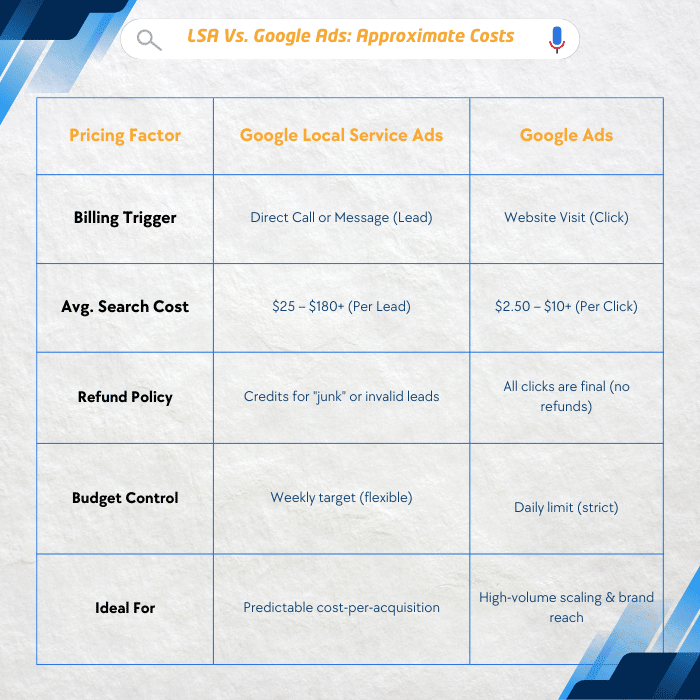
Understanding the Costs: LSA vs. Google Ads
When choosing between LSA and Google Ads, you aren’t just looking at the price tag: you’re looking at the cost structure. One platform charges for curiosity (clicks), while the other charges for intent (leads).
We must highlight that these figures are estimates based on 2026 industry benchmarks. Your actual costs will vary based on your specific zip code, your business’s review rating, and real-time local competition.
LSA: The “Pay-for-Results” Model
Local Service Ads are built for budget efficiency. Since the focus is purely on lead generation, your spending is directly tied to your phone ringing.
- Pay-Per-Lead: You only pay when a potential customer takes a real action.
- Variable Lead Costs: Depending on your niche, costs typically range from $25 to $150+ per lead. For example, home services (like HVAC) often see leads around $80–$100, while high-competition legal services can exceed $200 per lead.
- The “Junk Lead” Safeguard: A major benefit is the ability to dispute invalid leads (e.g., wrong service, out of area) within your dashboard to receive a credit.
Google Ads: The “Market Auction” Model
As we have mentioned so far, Google Ads work on a pay-per-click basis. This model offers more granular control but requires a more watchful eye on your daily spend.
- Variable Cost-Per-Click: The average cost-per-click across all industries in 2026 is approximately $2.69 for general searches. However, high-intent keywords in competitive fields are significantly higher. In the Legal sector, average costs sit around $9.21 per click, while Home Services (such as HVAC and plumbing) average roughly $6.55 per click.
- Budget Flexibility: Unlike the weekly targets used in Local Services Ads, Google Ads allows you to set strict daily budgets. This is ideal for businesses that want to scale up for a holiday promotion or pull back during a quiet week.
- The “Leakage” Risk: Because you pay for every click, a poorly optimized campaign can quickly “leak” money. If your ad attracts clicks but your website doesn’t convert those visitors into callers, your cost-per-lead will be much higher than expected.
Frequently Asked Questions
-
Can I use LSA and Google Ads together?
Yes. Many businesses use both platforms to maximize their online presence. While LSA is great for generating local leads with minimal effort, Google Ads can help you reach a broader audience and offer more control over your campaigns. Combining both allows you to target local customers through LSA and expand your reach with Google Ads.
-
Does my "Speed to Lead" impact my LSA ranking?
Yes, significantly. Google’s 2026 algorithm tracks how quickly you respond to messages and how often you answer calls through the LSA platform. If you consistently miss calls or take hours to reply to messages, Google will lower your ranking in favor of more responsive competitors. A fast response time isn't just good for the customer; it’s a direct ranking factor for your ad visibility. Check out our AI answering service to ensure you don’t miss any leads!
-
What happens to my ads if my insurance or license expires?
The LSA system is proactive about compliance. If your business insurance or professional license expires, Google will automatically pause your ads until you upload a renewed, valid document. This is why we recommend setting up alerts 30 days before expiration; losing your "Google Verified" status for even a few days can lead to a significant drop in your monthly lead volume. Navigating these requirements can be a full-time job in itself, which is why we offer Google LSA management to monitor your account’s health, manage renewals, and protect your 'Verified' status behind the scenes.
-
Can I track my ROI with LSA?
Yes! LSA provides a simple way to track the performance of your campaigns through its dashboard. You can monitor the number of leads you receive, whether they come from calls or messages, and assess the quality of these leads. For more comprehensive tracking and advanced analytics, many businesses choose to combine LSA with Google Ads or use a call tracking software.
-
Can I get a credit back if a lead doesn't book a job?
No. Google’s automated system only credits your account for invalid interactions such as spam, robocalls, or duplicate contacts. You cannot receive a credit simply because a legitimate prospect chose not to move forward with your services. This is precisely why active campaign management is essential; at Accelerate Marketing, we continuously refine your category settings, geographic targets, and ad scheduling to maximize lead quality, ensuring your budget is directed toward high-converting prospects.
Conclusion: Which Strategy Will Drive Your Growth?
Choosing between Local Services Ads and traditional Google Ads isn’t about finding the “best” platform; it’s about finding the right tool for your specific goals. For many local businesses, these two systems actually work best when paired together.
Managing these moving parts while focusing on your daily operations can be a challenge. If you need a partner to manage your LSA account or you want to use advanced call tracking to see exactly which ads are driving your revenue, our team is here to help you navigate the process.
Reach out for a free strategy session today and let’s find the most effective way to grow your local presence!