Last Updated: October 6th, 2026.
If you are a home service provider or local professional mapping out your marketing budget for 2026, you have likely searched for one simple question: “How much do Google Local Services Ads actually cost?”
The problem? It is getting harder to find a straight answer. While securing a low Cost Per Lead (CPL) feels like a win on paper, getting a cheap lead is not the actual goal; acquiring a profitable, booked job is.
Google recently removed its public LSA cost calculator, leaving many business owners completely in the dark on how to allocate their budgets. In this guide, we are pulling back the curtain.
Using our Google Partner access and agency-level tracking data, we are sharing real 2026 cost-per-lead baselines, what actually drives those prices, and how to optimize for the metrics that truly matter.
Where Did the Google LSA Calculator Go? (And How We Get the Data)
For years, local businesses relied on Google’s public LSA calculator to project their ad spend. Following Google’s deprecation of the public LSA cost calculator, business owners no longer have a direct, official reference point for baseline spend projections.
Lacking a reliable baseline creates two distinct operational risks: underbudgeting to the point of restricted ad impression share, or overspending on unqualified leads without a clear strategy for ROI.
To fill this gap, our team relies on our insider access as Google Local Service Ads Partners and real agency-level tracking data, such as numbers from active 60-day campaign lifecycles to project accurate costs. Having these baseline numbers prevents you from flying blind in highly competitive markets.
Inside Our Campaign Dashboards: The Real 2026 Cost of a Lead
While national benchmarks offer a solid baseline for preliminary planning, actual lead costs vary significantly depending on local competition, trade category, and ticket size. Since Google Local Services Ads operate on a pay-per-lead model, baseline pricing scales primarily around geographic density, job category, and average transaction value.
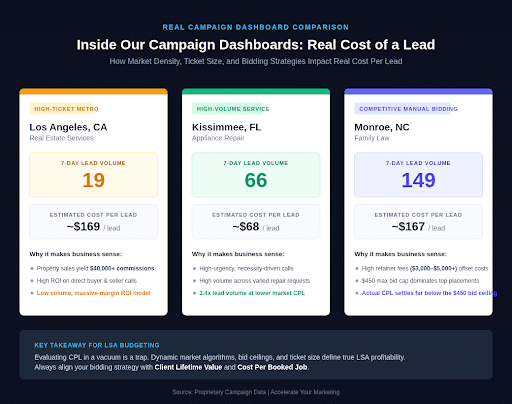
To see illustrate the variance is, let’s look at two of our active client campaigns, both running the exact same weekly budget under Google’s automated bidding:
Case 1: High-Ticket Metro Market (Los Angeles Real Estate)
- 7-Day Performance: 19 leads.
- Estimated Cost Per Lead: $169.
- Why it works: In the Los Angeles market, a single home sale might yield a $40,000+ commission. Paying $169+ for a direct phone call from a seller or buyer is a highly profitable cost of acquisition.
Case 2: High-Volume Home Service (Kissimmee, FL Appliance Repair)
- 7-Day Performance: 66 leads.
- Estimated Cost Per Lead: ~$68.
- Why it works: In a strong residential market like Kissimmee, appliance repair operates on high volume across varied service requests (refrigerators, washers, ovens). Because the local market dynamics are different and the average job size is lower, the exact same budget ceiling yielded more than three times the lead volume.
Case 3: Competitive Manual Bidding (Monroe, NC Family Law)
- 7-Day Performance: 149 leads.
- Estimated Cost Per Lead: ~$167.
- Why it works: Family law cases usually involve high retainer fees (often $3,000 to $5,000+). Paying $167 for a direct call from someone needing immediate legal help is highly profitable because just one signed client easily covers the cost of multiple leads.
The Takeaway
Evaluating Local Services Ads strictly by surface-level Cost Per Lead is a trap. As these three cases demonstrate, a “good” CPL is entirely relative to your market geography, service urgency, and average deal size.
- The Illusion of Bid Ceilings: Setting an aggressive maximum bid (like the $450 in the Family Law example) doesn’t mean you will pay that amount every time. It acts as a lever to win the auction and secure top placement, while Google often fulfills the leads at a much lower actual cost.
- Urgency vs. Ticket Size: High-ticket markets require a willingness to absorb premium acquisition costs for low-volume, massive-ROI deals. Conversely, necessity-based services thrive on capturing a high volume of lower-cost, rapidly converting leads.
- The Ultimate Metric: True LSA profitability comes down to aligning your bidding strategy and weekly budget limits with your specific client lifetime value, rather than just hunting for the cheapest possible lead.
What Actually Drives Your LSA Lead Price?
Rather than relying on static rates, Google’s platform calculates your daily lead cost based on three primary dynamic factors:
- Market & Geographic Density: Bidding in a highly competitive, densely populated metro area increases the baseline cost because more businesses are fighting for the top three ad spots.
- Service Category & Job Type: Google recognizes the value of the job being booked. A lead for a complete water heater replacement or a new roof inherently costs more than a lead for a routine maintenance check or minor repair.
- Profile Quality & The Three Rs: Google strictly controls which ads rotate into the highly coveted top three spots based on what we call “Three Rs”: Reviews, Radius, and Response Rate. A highly trusted, responsive profile can maximize budget efficiency and lower your overall cost of acquisition.
The Metric That Matters: Cost Per Lead vs. Cost Per Booked Job
Obsessing over securing the lowest possible Cost Per Lead is one of the most common budget traps for this ad model. To build a profitable campaign, you have to shift your focus to Cost Per Booked Job (or true Customer Acquisition Cost).
Consider the math behind two common scenarios:
- The $80 Lead (High Value): An $80 lead that your team answers immediately and converts into a $5,000 installation delivers an immediate, high Return on Ad Spend (ROAS).
- The $40 Lead (Total Loss): A $40 lead that goes to voicemail, never responds, or turns out to be an out-of-service caller yields a 0% booking rate. Because it generates zero revenue while burning ad dollars and sales capacity, that “cheaper” $40 lead represents a total loss of capital, making it far more expensive to your bottom line.
With Google’s algorithm setting baseline lead prices according to market demand, your true power as an advertiser lies in what happens after the lead comes in. Internal response times, phone conversion rates, and structured lead management dictate your ultimate profitability.
Manual lead disputes are officially a thing of the past. The platform scrapped the old manual review process in favor of an automated crediting system. Instead of you filing a claim for a refund, the system’s algorithm reviews charged calls behind the scenes within 72 hours, automatically applying credits for obvious errors like spam, duplicates, or wrong numbers.
Since you can’t push a “dispute” button anymore, your main tool for defense is the “Rate this lead” survey in your dashboard. Making a habit of marking bad calls as “Very dissatisfied” helps train the algorithm on what your business actually does, giving you the best shot at triggering a credit review.
Additionally, the ad network no longer issues credits for “out-of-area” requests or “job type not serviced.” Since manual disputing is no longer an option, partnering with LSA management experts is essential to configure your local targeting with absolute precision and ensure you only pay for calls that actually bring in profit.
The 2026 Platform Shift: LSA is Moving to Google Ads
Google has officially transitioned Local Services Ads management into the Google Ads interface. This structural update consolidates local lead generation alongside standard Pay-Per-Click and Search campaigns within a single dashboard, while keeping the core experience intact. Here is what you need to know:
What’s Changing | What Remains the Same |
|---|---|
PMax Transition: LSAs move into Performance Max campaigns inside the main Google Ads interface. | Pay-Per-Lead Model: You still only pay for valid lead connections (no charge for clicks or bounces). |
Centralized Lead Management: Moves fully to the ‘Leads’ tab under Goals > Conversions (handling, messaging, credits), replacing the old standalone LSA dashboard. | Premium Placements: Ads keep their top spots on Google Search and Google Maps. |
Budget & Interface: Weekly budgets convert to daily averages; management is entirely in Google Ads. No auto-transfer of history (manual export needed). | LSA Core Experience: High-visibility local lead generation remains at the forefront.
|
Manual Bidding: Manual bidding limits and Target CPA settings are being retired.
| Focus on Fundamentals: Cost efficiency still depends on answering calls quickly, syncing business profiles, and auditing leads. |
- Pay-Per-Lead Model Preserved: Advertisers continue to pay only for valid lead connections rather than clicks or website bouncers.
- Consistent Search & Maps Placements: Ads maintain their premier placements at the top of Google Search and Google Maps results.
- Centralized Lead Management: Lead handling, messaging, and credits move to the “Leads” tab (under Goals > Conversions) inside Google Ads, replacing the standalone LSA dashboard.
- Budget & Interface Realignment: Weekly budgets convert to equivalent daily average budgets, and management moves fully into the main Google Ads UI. Historical LSA reports will not automatically transfer, requiring advertisers to export past performance data manually.
Manual bidding limits and vertical-level Target CPA settings are being retired as campaign management shifts to Google Ads. In this unified environment, maintaining low acquisition costs relies on account health fundamentals:
1. Fast Lead Response: Answering calls promptly signals account activity and helps maintain top-three rotation.
2. Systematic Autocredit Management: Submitting invalid leads for credit prevents wasted ad spend from artificially inflating your actual cost per lead.
3. Active Profile Upkeep: Maintaining fresh reviews, updated business hours, and accurate service selections ensures the automated system directs budget toward your most profitable job types.
Frequently Asked Questions
-
If I get too busy and pause my LSA campaign, will it affect my costs when I turn it back on?
Yes. Pausing your campaign completely resets the algorithm's learning phase. When you turn your ads back on, you will likely see a temporary drop in visibility and higher, unpredictable lead costs while the system recalibrates. Instead of pausing completely, it is much more cost-effective to lower your budget to a minimum baseline so you keep your profile active and preserve your ranking momentum.
-
What happens if my LSA budget runs out before the week ends?
Once you hit your limit, Google stops showing your profile until the next billing cycle starts. While this keeps you from overspending, going offline mid-week hands high-value leads straight to your competitors and disrupts your campaign's success.
-
Does LSA moving into the main Google Ads interface change how I am billed?
No, the fundamental pay-per-lead model stays the same. You still only pay for valid calls or messages, not clicks. What changes is how budgets are set and managed: weekly budgets convert to equivalent daily averages, manual bidding limits are retired, and lead handling and autocredit workflows move to the "Leads" tab inside Google Ads.
Final Takeaways: Mastering Your LSA Strategy in 2026
Navigating Google Local Services Ads in 2026 requires looking far beyond basic lead costs. Whether you are paying $600+ for high-value leads in LA real estate or getting over 60 calls a week for appliance repair in Kissimmee, your baseline lead cost will always be dictated by market density, service category, and your commitment to the Three Rs: Reviews, Radius, and Response Rate.
While market prices set the baseline, your profitability depends on turning calls into booked jobs and managing invalid leads. Instead of spending time learning the new platform, automated bidding nuances, and daily account tweaks, you can let our LSA pros handle it for you.
Ready to stop wasting money on unqualified leads? Book a free audit with us and we’ll review your active targeting, analyze your lead survey submission workflow, and show you exactly where your campaign is leaking budget in 2026.