Call tracking numbers are dedicated phone numbers assigned to specific marketing channels, enabling you to see which efforts (whether they be online ads, social media posts, or offline campaigns) are actually driving customer calls.
It takes the guesswork out of your marketing. You’ll see which ads are making the phone ring and which ones aren’t and which platforms are sending you high-quality leads, so you can double down on what’s actually growing your business.
In this guide, we’ll explore everything you need to know about call tracking numbers, including how they work, the benefits they offer, and how to leverage them for improving both marketing and customer engagement outcomes.
How Call Tracking Numbers Work
Think of it as a smart lens for your marketing. It identifies where your caller found you, then instantly passes the customer to your real phone line so you can close the deal.
To use these effectively, you have to choose the right delivery method based on where the customer is looking:
- Fixed/Static Placement (The “Permanent” Tag): You assign one number to one specific place that doesn’t change, like a billboard, a business card, or your Instagram profile. It’s a 1-to-1 relationship.
- Dynamic Insertion (The “Digital” Switch): This is for your website. A small script “swaps” the number on your site in real-time. If User A comes from a Google Search, they see one number. If User B comes from a Facebook Ad, they see a different one. This allows you to track individual user journeys without cluttering your site with a dozen phone numbers.
The Logistics of the “Bridge”
When a lead dials a tracking number, three things happen instantly:
1. The Interception: The tracking software recognizes which specific campaign (e.g., your “Winter HVAC Special” flyer) is tied to that number.
2. The Data Log: Before the first ring, the system records the caller’s ID, geographic location, and the marketing source.
3. The Whisper: As you pick up the phone, some systems play a “whisper message” that only you hear (e.g., “Call from Summer Lawn Care Ad”), giving you the context to close the sale before even starting the conversation.
By assigning specific call tracking numbers to different campaigns or channels, businesses can accurately attribute calls to their marketing efforts and gain insights into which channels are most effective at driving customer engagement.
The Benefits of Call Tracking Numbers for Your Business
Think of call tracking as turning the lights on in a dark room. You stop guessing which marketing efforts are working and start seeing the actual path your customers take.
Here is how it changes things for your business:
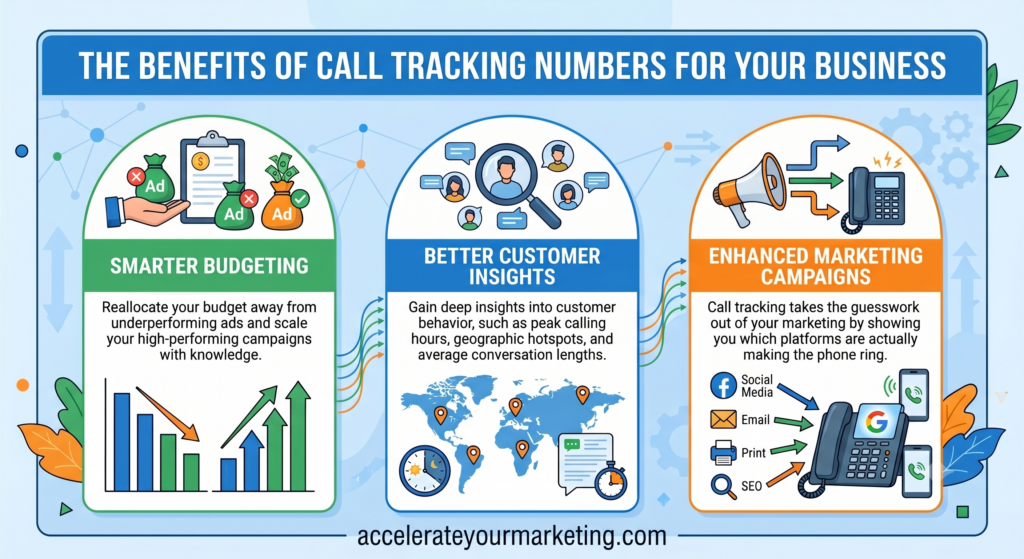
Smarter Budgeting (Stop Wasting Money)
Instead of wondering which ads are working, you get a ‘profit map.’ You can instantly see which campaigns bring in high-paying customers and which ones are just attracting ‘price shoppers.’ This lets you reallocate your budget away from underperforming ads and scale your high-performing campaigns with knowledge.
Better Customer Insights
Data is about more than just the “quantity” of leads; it’s about understanding the person on the other end of the line. Beyond simple call counts, you gain deep insights into customer behavior, such as peak calling hours, geographic hotspots, and average conversation lengths.
These “digital trust signals” help you identify emerging trends and service needs, allowing you to tailor your outreach to be more personalized and customer-centric.
Enhanced Marketing Campaigns
With real-time visibility into which campaigns are generating the highest call volume, you no longer have to wait until the end of the month to make changes.
Call tracking takes the guesswork out of your marketing by showing you which platforms are actually making the phone ring.
By understanding which creative assets or keywords are driving the most meaningful engagement, you can continuously improve your campaign performance and scale your business with confidence.
Choosing the Right Call Tracking Solution for Your Business
To fully leverage the power of call tracking numbers, you need a platform that does more than just “forward calls.” The right solution should act as a bridge between your phone line and your marketing data. Here is what to consider when selecting a platform:
1. Integration with Other Marketing Tools
Your call tracking platform should be a seamless extension of your existing tech stack. It must integrate seamlessly with tools like Google Analytics, your CRM system (such as HubSpot or Salesforce), and advertising platforms like Google’s Local Service Ads.
This connectivity ensures that when a lead calls, the data is automatically logged across your entire ecosystem, giving you a unified view of your customer interactions.
2. Automated Lead Qualification
A high-quality solution does more than just log a call; it helps you separate valuable leads from junk. Look for features like automated call scoring or AI-driven transcriptions that can highlight specific keywords (e.g., “appointment,” “estimate,” or “emergency”) within the conversation.
This allows you to quickly filter your data to see which marketing channels are driving paying customers rather than just general inquiries or wrong numbers.
3. User-Friendly Interface
Look for a platform that is simple to set up and manage. An intuitive, user-friendly interface allows you to analyze call recordings, manage your tracking numbers, and make data-driven decisions without getting bogged down in overly technical or complicated systems.
4. Scalability
Your call tracking solution should be able to grow with your business. As your marketing efforts expand, you should be able to scale your call tracking solution to track additional campaigns, locations, or products. Make sure your platform can handle increased data volume as your business grows.
5. AI Call Answering and Lead Capture
Tracking the call is only half the battle; the other half is ensuring the call is answered. Many businesses lose ROI because they simply can’t get to the phone in time.
This is where a solution like Accelerate Marketing’s AI answering agent becomes essential. By integrating an AI agent that answers calls and messages within 30 seconds, you guarantee a 100% response rate. This not only improves your Google rankings (which reward fast responses) but also ensures that the leads you are paying to track never slip through the cracks.
Best Practices for Maximizing the Value of Call Tracking Numbers
Implementing call tracking is just the first step. To get the most out of your investment, you need a structured approach.
Use this information to ensure you are starting small and focusing on the metrics that drive revenue:
- Prioritize High-Intent Channels: Start by only tracking your top three sources (e.g., Google Ads, Organic Search, and your Google Business Profile).
- Audit for Lead Quality: Once a week, scan your call logs to filter out “junk data” like robocalls or wrong numbers.
- Listen to “Missed” Calls: Review recordings of unanswered calls to see if you need to adjust your staffing hours or implement an AI Answering Agent.
- Tag Your Leads: Use your dashboard to tag calls as “Quote Requested,” “Booked,” or “Existing Customer” to see the true value of the traffic.
- Sync to Your CRM: Ensure every call automatically creates or updates a lead profile in your CRM so no follow-up is forgotten
Common Mistakes to Avoid
Even with the best tools, it’s easy to make errors that can actually hurt your rankings or muddy your data. Here are the most frequent pitfalls businesses encounter when using call tracking numbers.
Overcomplicating Your Setup
Even with the best tools, a few simple errors can muddy your data or even hurt your rankings. Here is what to watch out for:
- Overcomplicating the Setup: Don’t try to track 10 different KPIs on day one. Start small by tracking your primary channels—like Google Ads and Organic Search—before adding more layers.
- Ignoring NAP Consistency: Hard-coding different tracking numbers across the web is an SEO killer. To protect your rankings, always use Dynamic Number Insertion on your site and the “Primary/Secondary” number trick on your Google Business Profile. Learn more about this topic on our blog Do Call Tracking Numbers Hurt SEO?
- Neglecting Call Quality: Don’t get blinded by high call volume. Regularly audit your logs to ensure you aren’t paying for spam or wrong numbers, and use recordings to verify that your team is actually converting the leads.
- Failing to Integrate: Data is useless in a vacuum. If your call tracking isn’t synced with your CRM, you’ll lose the “lead-to-sale” connection that proves your true ROI.
Frequently Asked Questions
-
Is call tracking expensive?
Think of it as an investment that pays for itself by shining a light on "black hole" marketing campaigns. By using top of the line call monitoring services, you can identify exactly which ads are wasting your budget and stop paying for leads that don't convert. Most businesses find that the savings from cutting underperforming ads far outweigh the cost of the tracking software itself.
-
Do I need to use a different call tracking number for every campaign?
Our experts explain it best: "If you want to monitor individual progress and identify specific areas that need growth, a separate tracking number is highly suggested per account, vertical, and other sources." This granularity allows you to see exactly which campaigns are driving revenue and which ones need to be refined.
-
Will call tracking affect my customer experience?
Call tracking numbers should not negatively impact the customer experience. They are designed to work in the background, and your customers will only notice if they are asked to dial a specific number. The key is ensuring that your team is ready to answer calls professionally and promptly.
-
Can I track calls made to my business using a call tracking number, even if they are from mobile devices?
Yes, call tracking numbers work for both landline and mobile calls. As long as the call is made to the tracking number, the system will log the data regardless of whether it’s from a mobile phone or landline.
-
Does it work for service-based businesses?
Absolutely. For industries like HVAC, Law, or Dentistry, a phone call is often the primary way a lead becomes a client, making tracking essential.
Conclusion: Turning Data Into Growth
At the end of the day, call tracking isn’t about collecting call recordings or phone numbers; it’s about seeing which parts of your business are actually growing. When you move beyond basic call counts and focus on lead attribution and quality, you gain the clarity needed to stop guessing where your marketing budget should go.
But data is only the first half of the equation. As we’ve discussed, maintaining NAP consistency ensures customers find you, and high-quality call monitoring services show you how they got there.
Whether you are using these insights to coach your intake team or utilizing an always-on answering solution to ensure a 100% response rate, the goal remains the same. By guaranteeing instant connectivity with your callers, you can provide a better experience for your customers and a higher ROI for your business, ensuring that every lead you track becomes a lead you convert.
Ready to stop guessing and start scaling? Get in touch with our team today to see how call tracking can transform your lead generation strategy!