If you think getting a hundred reviews and walking away is enough to stay on top of Google Maps, the latest local ranking data has other news for you.
A recent study from Moz shows that reviews make up 16% of how search engines decide rankings, while research from BrightLocal has consistently shown that reviews older than 90 days are usually ignored by both the algorithm and potential clients.
Winning the Local 3-Pack requires continuous review velocity, where bringing in three to five fresh reviews every month matters far more than your historical total. A steady flow of feedback powers your entire local search strategy.
Google’s AI analyzes customer review text to answer natural language queries in AI Overviews, while Local Services Ads rely heavily on your star rating and ability to consistently gather reviews to dictate your ad rotation and top-of-page visibility.
Whether you rely on organic maps or paid leads, consistency is what turns local search impressions into paying clients.
The 3 Pillars of Local Ranking
Every time a potential client searches for your services, Google decides who ranks in the Map Pack based on three core factors: Relevance, Distance, and Prominence. Here is exactly how the algorithm weighs each one:
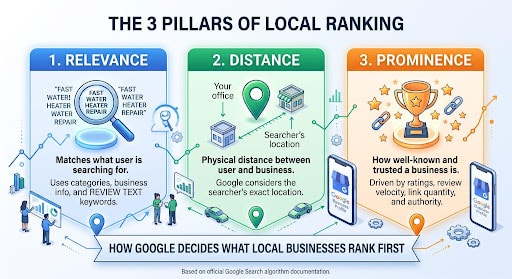
- Relevance: This measures how well your business profile matches what the user is actually searching for. While setting the correct primary category builds your baseline relevance, the actual words your clients use in their reviews act as massive relevance signals. When customers mention specific services in their feedback, Google uses those keywords to rank you for those exact searches.
- Distance: This refers to how close your physical office is to the person making the search. You cannot change your physical address to be closer to every searcher, but there is a major loophole. Businesses with an exceptionally high prominence score and continuous review velocity can often rank in a much wider geographic radius than competitors with weak review profiles.
- Prominence: This reflects how well-known and trusted your business is across the internet. Since you cannot control where a potential client is physically located when they search, prominence is the most powerful ranking factor that is entirely in your hands.
Google has confirmed that reviews are a major part of the motor behind your prominence score.
While the algorithm also looks at other data like how many websites link to your business, Google explicitly states that more reviews and positive ratings help improve your local ranking. Building this strong review profile makes it much easier to outrank competitors who might be physically closer to the searcher.
Beyond what the search algorithm thinks, recent BrightLocal research shows that 97% of consumers read online reviews for local businesses, and 41% say they always check reviews before deciding who to hire.
If your Google Business Profile is missing a solid foundation of recent reviews, even the best technical SEO will not turn those searchers into actual leads.
How AI Overviews Use Customer Reviews in 2026
Converting searchers into leads is the ultimate goal, but human beings are not the only ones reading your feedback today. The rise of generative search and AI Overviews means that a strong review profile now works twice as hard to build your online visibility.
Google’s AI does not just look at your overall star rating. It reads the actual text inside your customer reviews to answer specific questions.
If someone searches for the “best fast water heater repair near me,” the AI actively looks for those exact descriptive words. Because of this, a 4.7-star company with highly specific, detailed feedback can easily prioritize and outshine a company that only has generic 5-star ratings.
The Missing Link: How Reviews Dictate Local Services Ads
Many people treat organic SEO and paid ads like two completely different things, but they are deeply connected. Your review profile can be a block in the road for LSA success. Here is why:
LSA is Not Pay-to-Win
Unlike traditional Pay-Per-Click ads where you can simply outspend a competitor to secure the top spot, LSA operates entirely differently.
The search engine strictly controls which ads rotate into the highly coveted top three spots based on what our team calls the “Three Rs”: Reviews, Radius, and Response Rate.
While reviews act as the dominant ranking signal, you also need to optimize your Radius to include every zip code you are willing to service, and maintain a lightning-fast Response Rate to incoming leads.
To learn more about our Three Rs method, check out our full video walkthrough:
The Silent Penalty for Stale Reviews
You cannot buy your way out of a weak review profile.
Google wants to show the most trusted businesses at the top, and nothing says trustworthy like a steady stream of recent five-star reviews. A business with a massive marketing budget but stale reviews will consistently lose top ad placements to a competitor with a smaller budget who actively brings in fresh feedback.
Furthermore, if you get a large batch of reviews and then go completely silent, the algorithm assumes your business is inactive. This actively sabotages your ad rotation and causes sudden drops in your paid lead volume.
The Organic and Paid Synergy
Google explicitly states that customer reviews for Local Services Ads are managed entirely through your Google Business Profile, not your ads account.
The exact same reviews that push your organic Map Pack rankings higher are what give your Local Services Ads the high star rating and volume needed to stand out and book more jobs.
The 5 Review Signals That Move the Needle
When building a review strategy that actually drives leads, focusing on these five key signals consistently yields the best results:
1. Quantity: Having a solid review count gets your business in the game, though search algorithms weigh it alongside how often those reviews come in.
2. Velocity: Research from Whitespark shows that consistent, recurring reviews perform much better than getting a sudden batch all at once. Getting new reviews on a regular basis tells Google that your business is active and currently taking care of clients.
3. Recency: Both Google and real people lose trust in reviews that are older than three months.
4. Diversity: While your Google Business Profile is the main hub, getting reviews on sites like Yelp, Facebook, or industry directories proves to Google that your business is legitimate across the entire web.
5. Engagement: Replying to reviews is not just good manners. It actually helps convert people who read your profile. Taking time to reply to both good and bad reviews shows potential clients that you are running an active business and genuinely care about your work.
Authenticity Wins: Why a Perfect 5.0 Rating Isn’t Required
Many business owners panic over a single four-star review, but striving for a flawless 5.0 rating is actually unnecessary, and can sometimes backfire. Data from the Spiegel Research Center shows that a perfect score often looks fake or suspicious to modern consumers.
Instead of worrying about a flawless profile, embrace the fact that less-than-perfect reviews actually help your business in two ways:
- They build realistic trust: Consumer trust, and the likelihood to contact your business, actually peaks when a rating sits between 4 and 4.7 stars. People want to see real feedback, not just five-star bots.
- They provide a public stage: Future prospects read your replies to see what happens when things go wrong. A calm, professional response to a critical review often wins over more clients than a generic five-star rating ever could.
Frequently Asked Questions
-
Is getting too many reviews at once risky?
Yes, sudden spikes can raise flags. Getting a massive batch of reviews at once followed by total silence can look artificial to search algorithms. Maintaining a steady, predictable pace of new reviews looks far more authentic and produces much better long-term ranking stability than short, aggressive bursts. -
Why is responding to negative reviews worth the time?
Yes. Replying to reviews shows Google that your profile is actively managed. For consumers, seeing a calm, professional response to a negative review builds trust and makes them more likely to hire you.
-
Can I give clients a discount in exchange for a review?
No. Offering discounts, gift cards, or money for reviews breaks Google's rules and FTC guidelines. Doing this can get your reviews removed or get your Google Business Profile suspended completely.
Dominate Local Search Results
Treating your online reviews as an afterthought just does not work anymore. Whether you rely on organic map rankings or invest in Local Services Ads, getting regular reviews is what builds visibility, lowers ad costs, and earns consumer trust.
Putting a real review strategy in place is essential for any local business that wants to grow. If you want to rank higher in the Map Pack and get better results from your LSA, focusing on your reviews is the best place to start.
Ready to stop guessing and start building a predictable review pipeline? Connect with our SEO experts today to get a free audit and uncover growth opportunities.